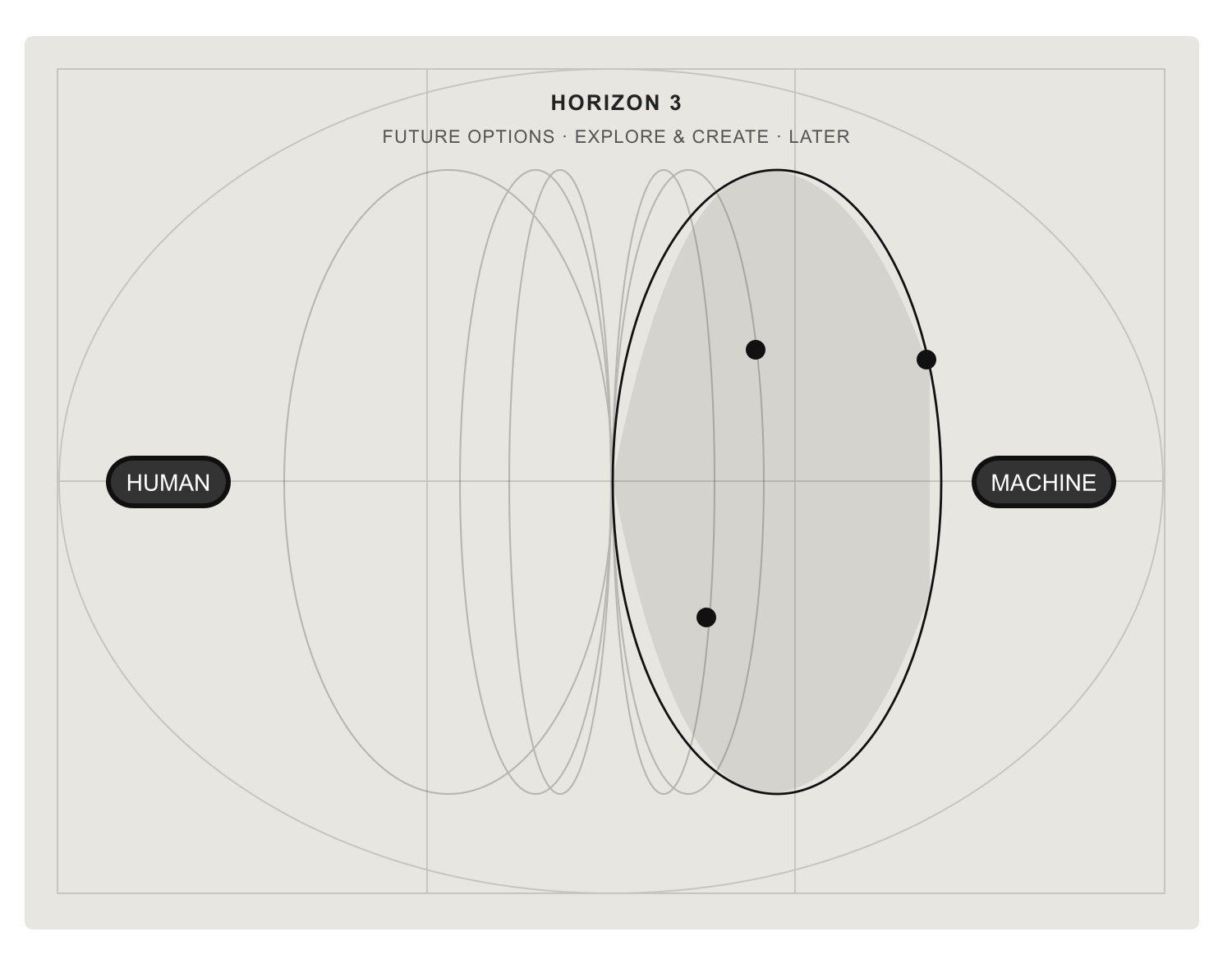
Value map
Where AI is changing cost, speed, quality or customer expectation in your market, and which parts of your current offer that strengthens, which it erodes, and how fast.
What changed in the market, what changed in the business and the question that follows from both.
AI can make work faster, cheaper or more scalable. But if the offer and commercial model remain unchanged, that advantage may never become revenue or margin.
The change can appear anywhere: in how a service is delivered, what a product can do, how customers are supported or which problems the business can now solve. It can weaken an existing source of value, or make an entirely new proposition possible.
Another technology pilot will not decide which opportunity customers will pay for.
The real question is not what AI can do. It is where your business can create and capture value next.
One cycle turns a strategic question into tested evidence. The work is commercial, operational and customer-facing at the same time.
We map where AI changes cost, speed, quality, scale or customer expectation in your market, and where that creates pressure or opportunity for your current offer.
We shape one proposition clearly enough to test: who it is for, what problem it solves, how it is delivered and why the customer would choose it.
We price it, put it in front of real buyers or internal budget holders, and record what they do rather than what they say.
We identify what has to change across people, technology and the business model before the proposition can become real.
Five things you can use to decide whether to invest, stop or keep testing.
Where AI is changing cost, speed, quality or customer expectation in your market, and which parts of your current offer that strengthens, which it erodes, and how fast.
Who it is for, what problem it solves, how it is delivered and why a buyer would choose it. Described precisely enough to price and test.
How the offer is packaged, priced and paid for, and what the unit economics look like at the price a buyer actually accepted.
What real buyers or internal budget holders did when shown the priced proposition. Recorded as what they did.
Invest, stop or keep testing, with the conditions attached: what has to change across people, systems and operating model before the offer can be real.
A new proposition only holds if people can run it, technology can support it and the business can make money from it. Those do not all move at the same speed, but none of them can be ignored.
One case, running now. A firm that bills by the hour is testing what replaces that when the hours fall away. The go/no-go has not been taken yet.
Accountancy firm · adoption and the commercial model
A firm that billed by the hour was about to make every saved hour uninvoiceable. The work changed, so the way that time was priced and packaged had to change with it.
This is the commercial pattern behind Horizon 3: when the work changes, the way value is captured has to change with it.
The five that come up before anyone commits budget.
The deliverable is a tested proposition. We price it, put it in front of real buyers or internal budget holders, and record their behaviour. You end with evidence and a decision, not a document.
One cycle, one proposition, described clearly enough to price and put in front of buyers. Small, reversible and measured—so commitment follows evidence instead of conviction.
Then that is the result, and it cost one cycle instead of a build. The cycle is designed to produce a decision: invest, stop, or keep testing. A no arrived at cheaply is worth more than a yes arrived at by momentum.
A lab produces concepts. This produces one proposition with a price, a buyer response and a view on whether the business can deliver it across people, technology and the operating model.
The people who can decide: commercial ownership, delivery, and whoever controls the budget. A proposition tested without them produces interest rather than a decision.
Usually intact, and better understood. Mapping where value is moving shows which parts of the current offer are strengthening, which are eroding, and how fast—which is useful even if you decide to build nothing new.
Every engagement begins with one defined result, a clear timeframe and a decision at the end. Four ways to start, from a two-day workshop to a twelve-week roadmap.
See how we startBring us one place where AI is changing the economics of your work, product or customer promise. We will help you decide whether there is a proposition worth building around it.